
A Toronto plumber asked us last spring why his Google Ads spend had climbed 40% year over year while his booked jobs stayed flat. The answer was not his campaign. It was that three competitors had moved into Google Local Services Ads, taken the top of the page above the paid results, and started paying only when a homeowner actually picked up the phone — while he was still paying for every click from every tire-kicker comparing prices at midnight.
Google Local Services Ads in Toronto are the single most under-used acquisition channel for trades and home-services businesses in the GTA. They sit above the regular search ads and above the Map Pack. They charge per lead rather than per click. And they are gated behind a licensing and insurance check that most of your competitors never bother to clear, which is precisely what makes the channel worth entering.
Key takeaways
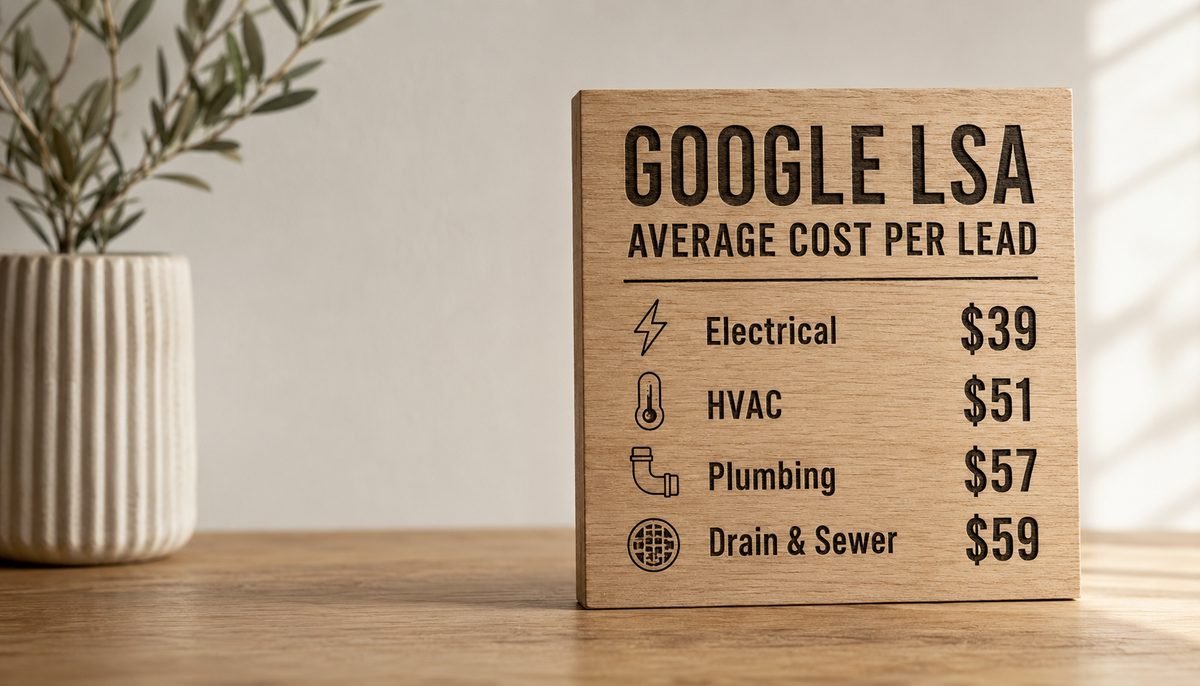
- LSAs charge per lead, not per click. The 2026 cross-trade average is about $53 per lead; electrical runs near $39, HVAC $51, plumbing $57, drain and sewer $59.
- The Google Guaranteed badge was retired on October 20, 2025 and folded into a single Google Verified checkmark. The money-back guarantee attached to it was discontinued.
- Eligibility is the real barrier: provincial trade licence, signed Certificate of Insurance, business registration and background checks on the business, owner and certain staff.
- Google ranks LSA profiles on bid, responsiveness, proximity and search relevance, enabled contact methods, and profile quality — reviews and answer rate dominate.
- Run LSAs for emergency and repair work; run Google Ads for installs, replacements and quoted projects. They are a pair, not a choice.
- Once Google asks for extra verification you have 14 days to supply it or your ads stop serving.
What Local Services Ads actually are
Local Services Ads are a separate Google product from Google Ads, with a separate dashboard, a separate billing model and a separate eligibility process. When a homeowner in Etobicoke searches "furnace not working," the LSA unit appears at the very top of the results — above the sponsored search ads, above the Map Pack, above the organic listings. Each entry shows a business name, a star rating, a review count, a Google Verified checkmark and a call button.
The billing difference is the whole point. Google Ads charges you when someone clicks through to your site, whether they call you or bounce in four seconds. LSAs charge you when a customer actually contacts you — a phone call, a message, or a booking made through the ad. You are buying conversations, not visits.
That changes the arithmetic in a way that matters for trades specifically. Home-services search traffic is heavily polluted with price-shoppers, students writing assignments, and people who wanted a YouTube tutorial. On a cost-per-click model you fund all of them. On a cost-per-lead model you fund none of them.
The trade-off is control. In LSAs you do not write ad copy, you do not choose keywords, and you do not send traffic to a landing page you designed. Google decides which searches you appear for based on the service categories you select and the area you serve. If you have spent years refining your messaging, that loss of control is genuine — and it is the main reason LSAs complement rather than replace a properly built Google Ads program.
The badge changed: Google Guaranteed is gone

This is the part most contractors and, frankly, most agency blog posts have not caught up with. On October 20, 2025, Google consolidated its Local Services badges. The green Google Guaranteed shield, the Google Screened badge used by professional services, and the License Verified by Google badge were all replaced by a single Google Verified checkmark displayed beside your business name.
Two things follow from that, and only one of them is cosmetic.
The cosmetic part: if you already held a badge, the transition was automatic and required nothing from you. Your profile simply started showing the new checkmark.
The part that actually matters: the Money Back Guarantee associated with the old Google Guaranteed badge was discontinued at the same time. Google no longer backstops the customer's dissatisfaction. For years, contractors used that guarantee as a closing argument — Google itself stands behind this work. That argument is gone, and any sales script, website page or brochure still making it is now inaccurate. If your site references the Google Guarantee, that copy needs to come down.
The strategic consequence is that trust has been redistributed. With the guarantee removed and every verified competitor showing the same identical checkmark, the badge no longer differentiates anyone. What differentiates you is your star rating, your review count and how fast you answer the phone. The badge is now table stakes; your reputation is the actual competitive asset — which is why LSA performance and Google Maps ranking rise and fall together.
What a lead really costs, by trade
Cost per lead varies by trade, by city and by how many competitors are bidding in your area at that moment. Across all categories the 2026 average sits near $53 per lead, with a realistic spread from roughly $25 to $150 and up. Here is where the common Toronto trades land:
| Trade category | Typical cost per lead | Lead urgency | What makes Toronto different |
|---|---|---|---|
| Electrical | ~$39 | Mixed | Panel upgrades and EV charger installs push higher-value jobs through a low-cost lead channel |
| HVAC | ~$51 | High, seasonal | Cost per lead spikes through the first cold snap and again in July heat waves |
| Plumbing | ~$57 | High | Dense competition across the GTA keeps bids elevated year-round |
| Drain & sewer | ~$59 | Very high | Aging infrastructure in older Toronto neighbourhoods drives consistent emergency volume |
Do not read those numbers as your marketing cost. Read them as the input to a different calculation. If drain leads cost you $59 and you convert one in three into a booked job averaging $600, your acquisition cost is $177 on a $600 ticket — roughly 30%, which is workable but not comfortable. Push that close rate to one in two and your cost drops to $118, or under 20%. The lead price is fixed by the market; your close rate is not, and it is where the actual margin lives.
Budgeting works differently too. Rather than bidding per click, you set a weekly budget and Google spends against it. Set it too low and you disappear during exactly the high-demand periods you most want to capture — the first freezing week of November is not the time for an HVAC business to be budget-capped. For a broader comparison of what paid acquisition costs in this market, our honest breakdown of Google Ads costs in Toronto covers the click-based side of the equation.
The eligibility gate: licence, insurance, background checks

This is where most applications stall, and it is also the channel's best feature. Every hour of paperwork is an hour a less organised competitor will not spend, which is why the LSA unit in most Toronto categories holds a handful of businesses rather than dozens.
For Canadian advertisers, Google's screening and verification requirements cover four areas:
- Business registration. Proof the business is officially registered and legally permitted to operate in Ontario.
- Provincial trade licence. For licensed categories — electricians and plumbers among them — you must supply a current, valid provincial trade licence for Google to verify. Expired licences are the single most common rejection.
- Insurance. A signed Certificate of Insurance for general or public liability, stating coverage amount, company or owner name and address. The name on the certificate must match the name used to sign up for Local Services Ads. "J. Smith Plumbing" on the certificate against "Smith Plumbing Inc." in the application will fail.
- Background checks. Google screens the business, the business owner and certain employees, including identity and criminal history research and cross-checks against national sex offender, terrorist and sanctions registries.
Two operational details worth writing on the wall. First, once Google requests additional verification you have 14 days to complete it or your ads stop serving — that clock does not pause for vacations or a lost email. Second, verification is not permanent. Licences and insurance certificates expire, and an expired document will pull your ads down without much warning. Put renewal dates in a shared calendar with a 45-day reminder, not a mental note.
The five levers that decide who Google shows
Google publishes what drives Local Services ad rank, and unlike much of its documentation it is fairly direct. Five levers matter:
- Your bid. The maximum you are willing to pay for a lead, though you often pay less. This is the least interesting lever and the one contractors over-index on.
- Responsiveness. How reliably and how quickly you answer inquiries. This is the lever that separates the top of the unit from the bottom. A missed LSA call is a bad customer experience in Google's eyes, and Google's remedy is to show someone who answers.
- Search relevance. The specific service being searched, the time of the search, and the customer's location relative to your service area. Proximity is real — set your radius across the entire GTA and you will lose leads in Scarborough to a business actually based in Scarborough.
- Communication options. Enabling message and booking leads alongside calls gives customers more ways to reach you and increases your contact opportunities.
- Profile quality. Your rating, review count, average response time, use of high-quality images and the verification checks you have completed.
Google also notes that ranking optimises for the overall health and diversity of the ecosystem, giving all providers some opportunity. Practically, that means you will not permanently monopolise the top slot no matter how well you optimise — and a new entrant with a clean profile is not locked out.
If you take one thing from this section: answer the phone. Responsiveness and review velocity outrank bid amount, and both are operational problems rather than marketing ones. The Toronto contractors who struggle with LSAs are almost never losing on budget. They are losing because calls ring out at 4:45pm on a Friday.
LSAs vs Google Ads: when each one wins
Framing these as alternatives is the mistake we correct most often. They solve different problems.
| Local Services Ads | Google Ads | |
|---|---|---|
| You pay for | Calls, messages, bookings | Clicks |
| Position | Above paid search and the Map Pack | Below the LSA unit |
| Setup barrier | High — licence, insurance, background checks | Low — a card and a campaign |
| Message control | None — Google builds the ad | Full — copy, landing page, audience |
| Best for | Emergency and repair calls | Installs, replacements, quoted projects |
| Weak for | Considered purchases, brand building | Low-margin urgent jobs where CPC waste hurts |
The pattern that works for most GTA trades: LSAs capture the burst pipe and the dead furnace, where the homeowner will call whoever appears first and answers. Google Ads captures the kitchen renovation and the full system replacement, where the customer researches for three weeks and needs to land on a page that proves you can do the work. If your business is weighted toward larger project work, your website is doing more of the selling than any ad is, which is a different conversation — one we cover in our work on websites for home renovation companies.
Disputing bad leads without burning your credibility
Not every lead you are charged for is a real lead. Google reassesses lead quality after the fact and issues credits in both the United States and Canada. Legitimate grounds for a dispute include a caller looking for a service you do not offer, a job outside your service area, obvious spam, or a wrong number.
Three rules make disputes work. Submit them promptly rather than batching a month's worth. Give a specific reason — "caller wanted appliance repair, we are a plumbing contractor" beats "bad lead." And dispute only what genuinely qualifies. A prospect who called, heard your price and went elsewhere is a real lead you lost, not a billing error, and a pattern of aggressive claims invites closer scrutiny of every future one.
The habit worth building is reviewing disputed leads weekly and looking for the pattern behind them. A run of out-of-area calls usually means your service radius is drawn wrong. A run of wrong-category calls usually means you have selected service categories you do not actually want work in.
The 30-day Toronto launch plan
This is the sequence we run for a trades client entering LSAs from zero. Verification timing is the variable you cannot fully control, so start the paperwork on day one.
- Days 1–3. Gather documents before touching the dashboard: business registration, current provincial trade licence, signed Certificate of Insurance. Confirm the legal business name matches across all three, exactly.
- Days 4–7. Create the Local Services account, select service categories deliberately rather than checking everything, and submit for verification. Begin background checks immediately — they are the longest pole.
- Days 8–14. While verification runs, fix operations. Establish who answers LSA calls and during which hours, and set up coverage for evenings and weekends if you take emergency work. Google is measuring your answer rate from the first day you serve.
- Days 15–21. Build the profile properly: high-quality photos of real work and real vehicles, accurate business hours, tight service areas drawn around where you actually want to drive. Enable message and booking leads, not just calls.
- Days 22–25. Set an honest weekly budget. Start conservative, but not so low that you vanish during peak demand. Watch cost per lead daily for the first two weeks.
- Days 26–30. Build the review engine. Ask every completed job for a Google review, send the direct link by text the same day, and respond to all of them. Review count and rating feed both LSA rank and Map Pack rank simultaneously.
Mistakes we see Toronto trades make
- Drawing the service area across the whole GTA. Proximity is a ranking input. A radius from Oshawa to Oakville makes you the second choice everywhere instead of the first choice somewhere.
- Letting calls ring out. The most expensive mistake available. Missed calls suppress rank, which reduces lead volume, which looks like a budget problem and gets solved with more budget. It is not a budget problem.
- Selecting every service category. Broad category selection buys leads for work you do not want, at full price, and disputes will not recover most of them.
- Still advertising the Google Guarantee. It no longer exists. Check your website, vehicle wraps and email signatures.
- Treating LSAs as a replacement for the website. LSAs generate the call. Everything after the call — the quote, the follow-up, the reason a homeowner picks you over the next verified checkmark — runs through your site and your reputation.
- Ignoring licence and insurance expiry dates. Ads stop serving with very little warning, and re-verification is not instant.
Getting this running for your shop
Local Services Ads reward operational discipline more than marketing budget. The businesses that win the GTA units are the ones with current paperwork, a phone that gets answered, a steady flow of recent reviews, and a service area drawn honestly. None of that is glamorous, and all of it is learnable.
If you would rather not spend a month working out the verification process, Creative Scope sets up and manages Local Services Ads alongside Google Ads and local SEO for trades and home-services businesses across Toronto and the GTA. We handle the documentation, build the profile, run the review engine and manage the budget against booked jobs rather than raw lead count.
Call us at (905) 746-9209 or get in touch here and we will tell you honestly whether LSAs are the right channel for your trade — including when they are not.
For related reading, see our 2026 breakdown of Google Ads costs in Toronto, our Google Maps ranking playbook, or keep reading the blog.


